> For the complete documentation index, see [llms.txt](https://docs.pinot.apache.org/llms.txt). Markdown versions of documentation pages are available by appending `.md` to page URLs; this page is available as [Markdown](https://docs.pinot.apache.org/release-1.4.0/for-users/user-guide-query/multi-stage-query/join-strategies/random-+-broadcast-join-strategy.md).
# Random + broadcast join strategy
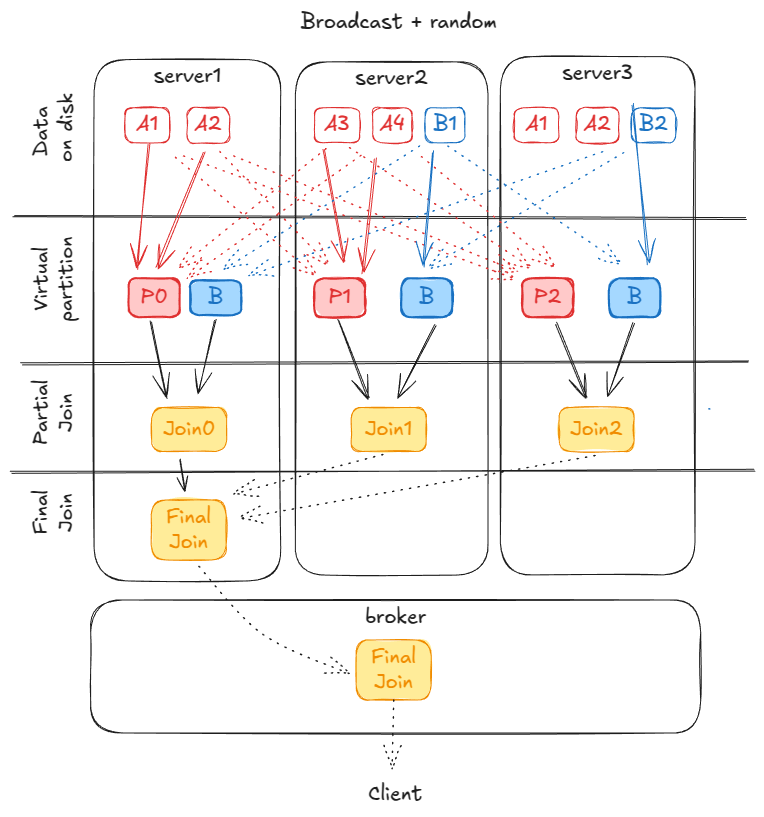
In order to execute joins, Pinot creates virtual partitions at query time. The more general way to do so is to assign a random partition to each row of the table. Each partition is then assigned to a server, and the join is executed in a distributed manner.
This partition technique can be applied to one of the tables in the join, but not to both. Otherwise, the result wouldn't be correct as some of the pairs of rows would be lost and never joined. Therefore what Pinot does is partition one of the tables and broadcast the other one.
Dotted arrows mean shuffle while solid arrows mean in-server transfer
This technique is used by Pinot when no other technique (like semantic virtual partition or colocated joins) can be used. For example, on queries like:
```sql
SELECT A.col1, B.col2
FROM A
JOIN B
ON A.col2 > B.col3 or A.col4 < B.col4
```
As always, Pinot assumes that the right table is the smallest, so that is the one that is broadcasted. When this technique is used, the number of rows that are shuffled can be upper-bounded by `count(A) + count(B) * number of servers` .
---
# Agent Instructions
This documentation is published with GitBook. GitBook is the documentation platform designed so that both humans and AI agents can read, navigate, and reason over technical content effectively. Learn more at gitbook.com.
## Querying This Documentation
If you need additional information that is not directly available in this page, you can query the documentation by asking a question.
Perform an HTTP GET request on the following URL with the `ask` and `goal` query parameters:
```
GET https://docs.pinot.apache.org/release-1.4.0/for-users/user-guide-query/multi-stage-query/join-strategies/random-+-broadcast-join-strategy.md?ask=&goal=
```
`ask` is the immediate question: it should be specific, self-contained, and written in natural language.
`goal` is what the user is ultimately trying to achieve, the reason they need the answer. Sharing it helps GitBook give you a better, more relevant answer. A goal is most helpful when it describes the outcome the user wants rather than restating the question. For example, with `ask=how do I create an API token`, a goal like `automate deployments from our CI pipeline` lets GitBook tailor the answer to that use case.
The response will contain a direct answer to the question and relevant excerpts and sources from the documentation.
Use this mechanism when the answer is not explicitly present in the current page, you need clarification or additional context, or you want to retrieve related documentation sections.